
Growing Well...Together?
A closer look at Kitchener's Official Plan and two concerning amendments

(This post runs quite long so you may need to click to read it your browser. Also, if you don’t have time to read the entire post, please scroll to the Call to Action at the end.)
Kitchener’s new Official Plan aims to spread growth more evenly throughout the entire city. But council is limiting heights in parts of Westmount and the Auditorium neighbourhood. That contradiction is coming back for discussion on June 29th and I think it’s worth paying attention to.
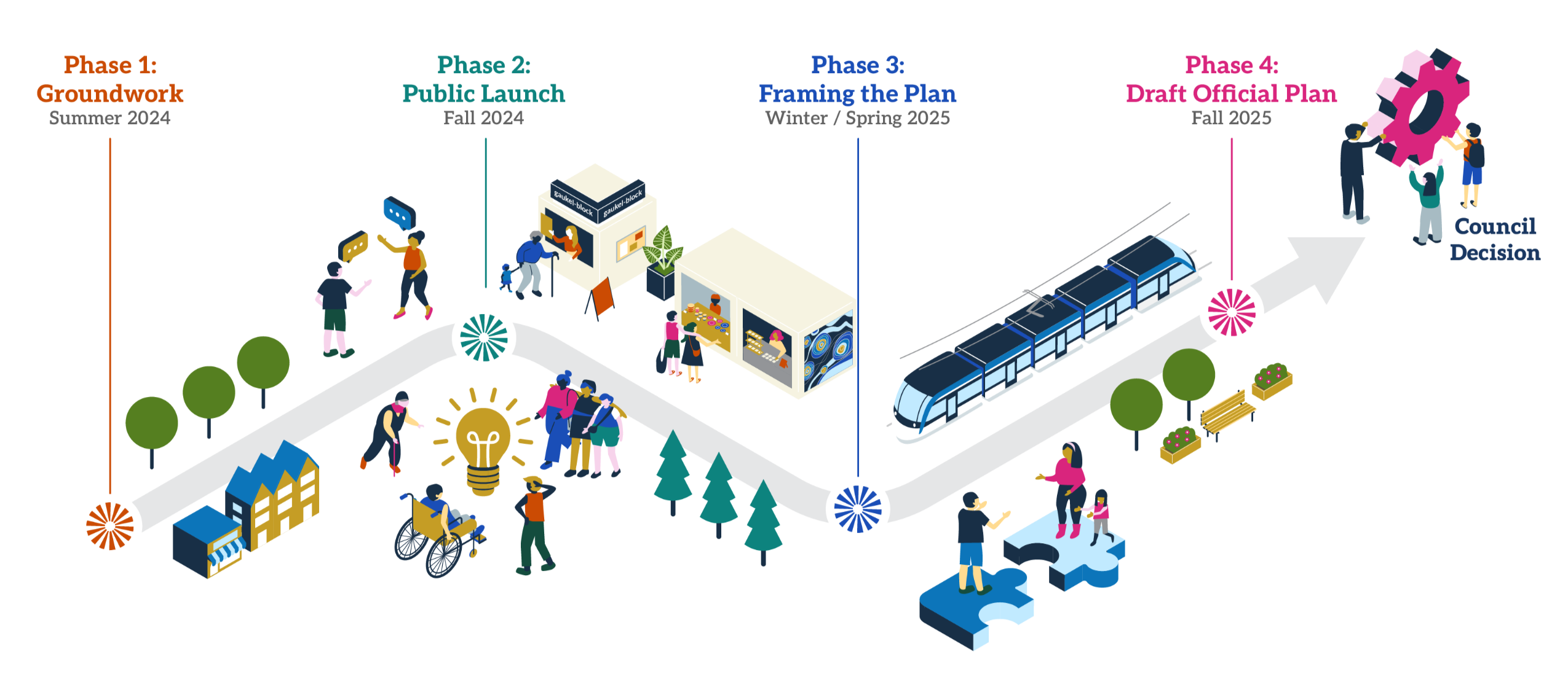
I spoke at the June 1st public input session largely in support of staff’s draft Official Plan. At that meeting (see link below), Councillors Johnston (ward 8) and Stretch (ward 10) put forth amendments to the Official Plan that would see staff recommendations for growth across the city limited in both the Westmount and Auditorium neighbourhoods. These councillors raised the amendments as residents in these neighbourhoods argued that due to the unique character and history of their part of the city, those neighbourhoods should not have the same expectations of growth and density that all other neighbourhoods may potentially see.
The amendments
Johnston’s amendment asks for “a 3-storey maximum building height, removal of the Strategic Growth Area city structure element from the two neighbourhoods, a prohibition on non-residential uses (neighbourhood-compatible commercial uses), and neighbourhood-specific cultural heritage landscape policies for the Westmount neighbourhood.” Councillor Stretch’s amendment was similar in placing limits to height and density in some areas of the Auditorium neighbourhood.
The staff reports states that, “by applying a maximum height of 3-storeys in (Westmount), the City would be planning for approximately 150 fewer homes, 270 fewer residents and 40 fewer jobs by 2051.”
The report also notes that if “maximum heights of 3-storeys applied to all central neighbourhood Cultural Heritage Landscapes (CHL), the City would be planning for 5,500 fewer homes, 10,000 fewer residents and 1,500 fewer jobs by 2051.” Of course, that doesn’t mean that those 10,000 residents cease to exist. Rather, “it means that this growth will occur unpredictably in neighbourhoods where it has not been planned for and is not expected. This could result in development delivering both greater negative impacts (e.g., requiring infrastructure upgrades) and fewer positive impacts at the same time (e.g., more homes built farther away from transit, local shops and services).”
Staff conclude that “placing limitations on building height to low-rise forms across neighbourhood CHLs will restrict as-of-right opportunities for missing middle housing in these neighbourhoods reducing housing options that staff heard was a clear priority of the community.”
Building an inclusive city
The Kitchener 2051 Official Plan (OP) is “the long-term vision for an equitable and inclusive Kitchener, as a thriving, connected, green and, above all, caring city,” said Rosa Bustamante, the city’s director of planning and housing policy.
The draft OP identifies portions of the Westmount neighbourhood (west of Belmont Avenue), as a strategic growth area, with the rest of the neighbourhood classed as either a neighbourhood growth area or green space. Neighbourhood areas would allow building heights of up to six storeys.
“The draft plan says strategic growth areas throughout the city offer the greatest opportunities for growth, while neighbourhood growth areas can provide modest but meaningful growth.”
Some Westmount residents believe this amount of potential intensification may “irreparably damage the historic area.” They’re asking for a height limit of three storeys, as well as limits on commercial uses, and “establishing Westmount as a heritage conservation district under the Ontario Heritage Act.”
“Intensification will dramatically change the feeling of community said resident Monica Reid. These changes would be the beginning of the end of Westmount as we know it.”
Some Auditorium residents also shared their concerns. “As a taxpayer who is relying on maintaining my property value upon retirement, I am extremely concerned about the prospect of having 3, 6 and 8 storey properties constructed in our historical neighbourhood,” says Sandra Feick.
Of course, there are some people who seemingly believe that people who live in apartment buildings are almost a different species entirely who don’t care about their neighbours or community.
“No matter what, the 6-8 storey structures will be an eyesore. Mature trees - gone. Close neighbourhoods - gone. A sense of security - gone. I love that I know so many of my neighbours and that we truly watch out for each other and care for this community. Apartment buildings will destroy that.”
While council is hearing complaints from some residents, planning staff have engaged in over 3000 community conversations about growing our city well. Manager of policy and research Natalie Goss said those consultations “found many people want to be able to stay in their neighbourhood of choice at different stages of their lives, and that is something that staff has taken to heart.”
Martin Asling of Waterloo Region Yes In My Backyard (a group I am a part of) is largely supportive of the Kitchener 2051 Official Plan which sees more housing spread throughout the city. During his delegation, Asling argued that, “You’ll of course get pushback, especially at the neighbourhood level, whenever you’re proposing more housing. But we can’t rely entirely on nodes and corridors. We need to have it through neighbourhoods as well.”
Respect the process:
Indeed, pushback is expected as change can be difficult. What council should remember as they consider these amendments is that city staff have been engaged in community consultations on various planning processes including Kitchener 2051 and Growing Together for years now. And this isn’t just your average fill-out-the-questionnaire engagement; it was award-winning…literally.
Public consultations included some innovative online and in-person engagements, the Gaukel Block launch party, a community working group with representation from each ward, a Speaker Series, and thousands of conversations in community spaces. That engagement “meaningfully embeds the community’s aspirations for a Thriving City, a Connected City and a Green City. Most of all, the Plan embodies–from start to finish–Our Shared Vision of Being a Caring City. Building a city for everyone where, together, we take care of the world around us–and each other.”
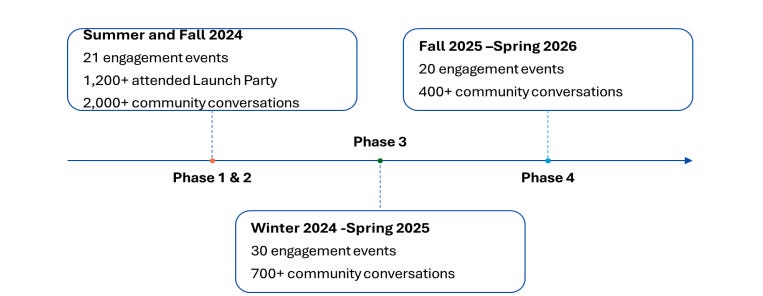
Through all of this, staff tracked the feedback received and consistently reported “What They Heard”. Click to read the Phase 1 & 2 What We Heard report. You can visit the Engage Kitchener page to read additional ‘What We Heard’ reports from phase 3 and 4.
As is expected, feedback ranges from supportive of density to those who want their neighbourhood to remain largely unchanged. We see similar narratives play out at local council meetings when new developments are proposed. When a condo building was proposed at 660 Belmont, at the edge of the Westmount neighbourhood, many residents shared their concerns about the proposal.
However, several residents also welcomed the increased density. As Councillor Dave Schnider (ward 2) mentioned at a recent committee meeting, while there is pushback against density in and around the Westmount neighbourhood, there are also those who support it, referencing some of the positive support for the proposed condo building in Belmont Village in 2022.
One supporter was Monica Jutzi, owner of Janet Lynn’s Bistro. “Change is always difficult to accept and for some the vision of a new building development isn’t in their future plans but we all need to look to the future and what is best for not only Belmont Village but for the City of Kitchener,” shared Jutzi.
The draft Official Plan “includes a city structure that is based on accommodating more people and jobs in close proximity to frequent transit like ION stations and proposed frequent transit routes like those along Westmount Road and Belmont Avenue, high quality trails like the Iron Horse Trail, and shops and services, such as those found in Belmont Village.”
After thousands of community conversations, staff identified the following “Big Ideas” as areas to focus on:
A Thriving City is one where every neighbourhood thrives.
A Connected City is one where every neighbourhood is connected.
A Green City is one where we all do our part to live more sustainably, and
A Caring City is one where people are welcome in all neighbourhoods, not just some
Throughout the Official Plan report, staff make it clear that the plan only works when every neighbourhood plays a part. “These Big Ideas cannot be achieved if they are only applied through some policies but not others. A patchwork approach to city building can lead to contradictions in how Our Shared Vision is implemented and make it more difficult to achieve the objectives set out in the Plan.”
Perhaps, like me, you took the opportunity to participate in the engagement process. I took the time to read the plans and participate in various aspects of the process. I appreciated staff’s efforts to develop a plan that allows our city to grow well in every neighbourhood. Now I see that some areas of the city want to opt out of these changes. If these exemptions are allowed, I’m left wondering what will motivate residents to engage in future initiatives when we see council bend to a handful of residents with the time and resources to organize well. It seems to me that these last‑minute exemptions undermine the integrity of the years-long process and the trust residents placed in it.
We’re all in this together…or are we?
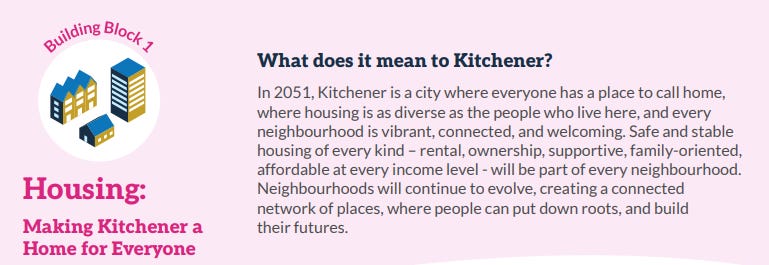
Kitchener’s vision is: building a city for everyone where, together, we take care of the world around us – and each other. From what I can tell, the Official Plan strives to align with that vision, asking each of us to participate in building a city that works for everyone. Housing is an important part of that. (On a similar note, you can read about the 100 Victoria encampment decision here.)
“The approach to growth … represents an intentional shift toward expanded housing options being available in all neighbourhoods across the city, particularly missing middle housing,” said senior planner John Zunic.
Missing middle housing ranges from low-rise properties like semis and townhouses to six to eight-storey mid-rise buildings. The official plan will allow buildings up to six storeys in areas designated as ‘neighbourhoods’ throughout the city. “To achieve positive changes anywhere, they have to be enabled everywhere,” Zunic said.
I tend to agree and said so when I delegated at the June 1st meeting. “Seeing your beloved neighbourhood grow up can feel unsettling, perhaps. But this plan reinforces an important principle — if we want a city where everyone is welcome, then every neighbourhood must share in accommodating growth.”
In order to offer more housing choice and affordability throughout Kitchener, the plan “enables balanced growth in all neighbourhoods and continues to plan for the most change in the areas where it creates the greatest benefit to all; Downtown Kitchener, Protected Major Transit Station Areas, and urban centres. But it also enables proportional growth outside of these areas, allowing every neighbourhood to respond to the needs of our community.”
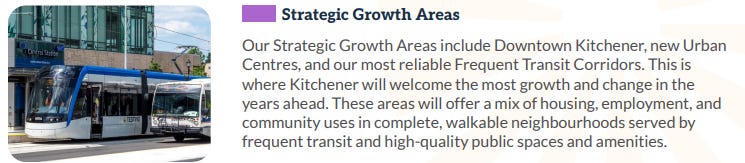
Again, this makes a lot of sense. Most density will still be directed to specific ‘growth areas’, but every neighbourhood must contribute to growth in some way. Staff say that these rules mean that the Westmount neighbourhood should expect to see approximately 150 new homes over the 25 years of this plan. That feels like a very reasonable expectation for such an amenity-rich neighbourhood. As Strong Towns founder, Charles Marohn says, “no neighborhood can be exempt from change and no neighborhood should experience sudden, radical change.” The official plan ensures that Westmount and Auditorium neighbourhoods won’t have to face radical change but they must accept some change over the next quarter-century.
As a bit of an aside, it’s worth noting that at the same council meeting that staff unanimously supported the amendments to limit intensification in the Westmount and Auditorium neighbourhoods, they also unanimously supported two 50+ storey towers without a question or comment. I’m all for more density, especially near the ion, but should we not at least be asking some questions about the quality of a development of this size such as the number (and speed) of elevators, the quality of soundproofing, etc.?
The residents pushing for limited growth in their neighbourhoods seemingly see a small increase in density as a threat. In reality, I believe it’s an opportunity. The staff report outlines it well: “This small change will mean that more families can remain in their neighbourhoods as they grow and as their needs change. Young children can live closer to their grandparents and other family members. People with special needs can still live independently, with their caretakers living next door. New Canadians and people migrating from other cities and provinces can choose which neighbourhood they want to live in, and bring their culture, skills and experiences to all parts of the city.”
During public engagement, the cost of housing came up often, with participants emphasizing the importance of ensuring that housing remains accessible for people at different life stages and income levels. Staff are concerned that exempting some neighbourhoods from this Plan “leads to contradictions in how Our Shared Vision is implemented. For example, voicing support for missing middle and affordable housing options while implementing policies that make it difficult to build or restrict it outright, will result in missing middle housing not being built.” It seems that we need to decide if we are really all in this together or not.
Is there a better way than tall and sprawl?
As I mentioned earlier, Council approved two tall buildings at this same meeting. Limiting growth in density in some neighbourhoods means that most growth is directed to small pockets of land in a city, leading to a phenomenon known as tall and sprawl. The ‘tall and sprawl’ pattern “effectively means one in five residents across three local cities is not part of efforts to intensify the use of land.” The draft Official Plan seeks to change that unsustainable trend.
As one delegate noted at the April 20th meeting, “allowing for more housing puts downward pressure on housing costs and helps mitigate the extreme pressure high housing demand is putting on our housing market. This is a fundamental matter of justice and equal opportunity because when we allow housing costs to rise as much as they have in recent years, we push people out of our often thriving neighborhoods and city.”
Those residents seeking exemptions for their neighbourhood often want to keep their beloved neighbourhood exactly as it is, largely ignoring the many changes that occurred to make it what it is today. It’s usually mixed with a good amount of nostalgia as well.
As quoted in the Record, “Stretch acknowledged that not everyone in the Aud neighbourhood supports the three-storey limit. But she said another resident’s description of the area as a Sesame Street experience captured its uniqueness.” As I shared on Bluesky, I think that’s a fundamental misunderstanding of the essence of the Sesame Street neighbourhood.
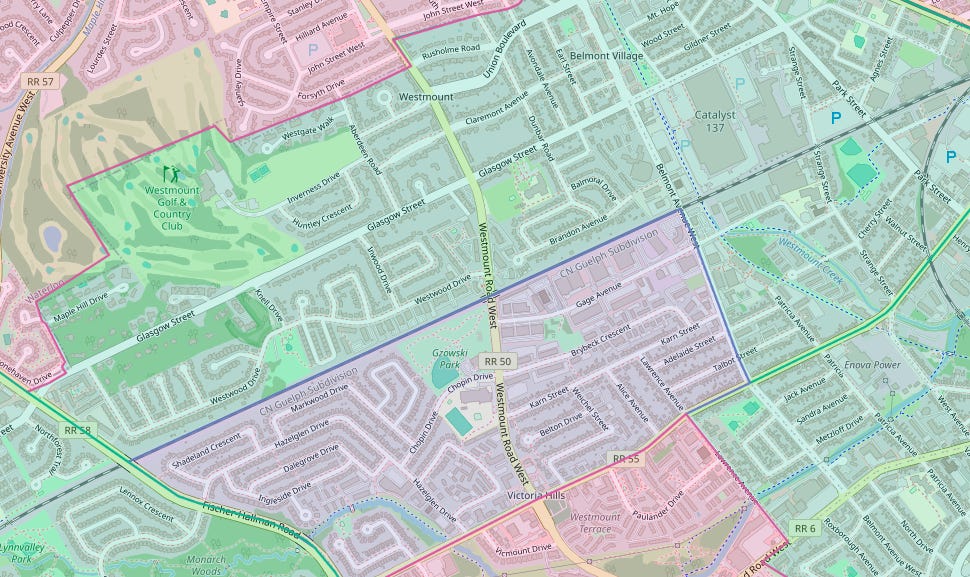
It’s also worth noting that the Westmount neighbourhood is an amenity-rich area that allows its residents easy access to services like parks, green space, transit, healthcare, and community space. The grassroots group One Million Neighbours created a mapping exercise that essentially asks which neighbourhoods have abundant access to these amenities and which ones need more investment?
“This map is one way we are measuring progress towards the One Million Neighbours vision, created by non-profits and community groups across Waterloo Region.”
If we zoom into the Westmount area, we see that the neighbourhood is in green, indicating the most access to important neighbourhood services and amenities. Areas in red have average access and purple has the least access. It seems to me that building an equitable and inclusive city means ensuring more residents are in amenity-rich neighbourhoods.
Staff also shared that “the value of greenspace was a consistent theme, with participants stressing the importance of having accessible parks and natural areas nearby, where they can relax, recharge, and connect with others.”
Long term vision instead of short term politics
It’s important to remember that this is a long-term document, spanning the next 25 years. While I understand Council’s desire to make compromises on specific developments, we should not accept concessions for such an essential guiding document, especially one that intentionally sought input from residents across the city. As staff write in their report, “a 25‑year plan should not be compromised by short‑term discomfort or neighbourhood‑specific carve‑outs.”
In addition to the years-long engagement process, the draft Official Plan intentionally builds on previous work of Kitchener Council.
In 2023, Council committed to the Municipal Housing Pledge which states, “Our growing and vibrant community will continue to welcome new people in all neighbourhoods in a variety of housing forms as we grow and change.”
We saw Kitchener Council declare a Climate Crisis in 2019 which stated “land use policies to encourage growth through infill development, particularly near transit, are by far the most impactful way for a city to reduce its greenhouse gas emissions.” The staff report says, “The most impactful thing that the City can do to protect our environment and reduce greenhouse gas emissions is by intentionally and pragmatically directing growth to existing neighbourhoods that are served by existing infrastructure and frequent transit, adding more homes close to shops, services, parks, and schools.”
The Official Plan also builds on Kitchener’s Strategic Vision, Growing Together, the Missing Middle and Affordable Housing report, and more.
The Official Plan “enables balanced growth across the city—not just in a few areas—while still directing the most change to Downtown, MTSA areas, and urban centres.” The modest and incremental density expected in residential neighbourhoods is essential for long‑term sustainability and affordability, while also meaningfully contributing to our much-need housing supply. Council’s planning decisions must reflect our city’s future needs, not simply react to the present discomfort with change of some residents.
A better way forward:
I don’t doubt that Councillors Johnston and Stretch have done a ton of work up to this point working with concerned residents about this proposed density. I actually don’t think that all needs to be thrown away if Council rejects their amendments. I think there is a better way forward that directs the passion of these residents, not to reject the proposed density, but rather to help shape the density that is expected over the next 25 years.
Listening to these council meetings, we often heard about the unique character of the neighbourhood that residents don’t want to lose. They are proud of the history that saw many professionals and entrepreneurs settle here. Perhaps the best way to honour that history is to help shape development that has space for upcoming professionals and entrepreneurs as they are just starting out. When they are students looking for housing they can afford through their schooling. Or perhaps, they could help create work-live spaces for entrepreneurs who are just beginning their journey.
As noted in the staff report, “Kitchener is built on small businesses and innovative spirit, but it can be expensive and risky to start a new business and difficult to find adequate, affordable space. The Plan will help more people get their start; opening a small flower shop or bakery in the front of their home, creating and selling art out of their garage, or 3D-printing prototypes in their basement.”
It seems to me that this approach does much more to honour the legacy of the neighbourhood more than refusing to include an additional 150 homes over the next quarter-century.
Conclusion
The Official Plan creates new land uses that enable more housing and more jobs across the city, creating choices for where people can live and work, and providing opportunities for connections and play. This incremental, equitable, and modest density across all neighbourhoods is essential for a welcoming, sustainable, and fair city.

Staff remind us that, “real change, on the ground, happens incrementally over a long period of time. This Plan helps care for the most vulnerable and improves quality of life for all – from taking visiting friends and family to the ‘must-try’ ice cream shop just down the street, to going for a long walk on a quiet trail next to a recently renaturalized stream, to hopping on transit and catching a concert in one of our urban centers.”
Council amendments that exempt certain neighbourhoods contradict the very engagement process that shaped the Plan. Instead, I encourage Council to support a plan that reflects the values and aspirations expressed through the community engagement process.
A Call to Action
Well, that was a long one and if you got to this point, good on you! To quote from the greatest movie of all time (comment below if you know it!), “If you've come this far, maybe you're willing to come a little further." This goes to Council for final approval on June 29th. If you agree that Council should adopt staff’s plan without exempting some neighbourhoods, please reach out with a quick phone call or email. Or consider delegating or submitting a written response.
Additional Reading
New Kitchener growth plan brings taller buildings, more density to more neighbourhoods
June 1st Planning & Strategic Initiatives Committee agenda, with many attachments and written submissions
Westmount Neighbourhood Cultural Heritage Landscape Research
Info about heritage conservation in Kitchener
Thanks for your important reporting work here!
Thanks for the heads up Melissa. Email sent to my councillor asking him to oppose this amendment.